 By Marcus Chen

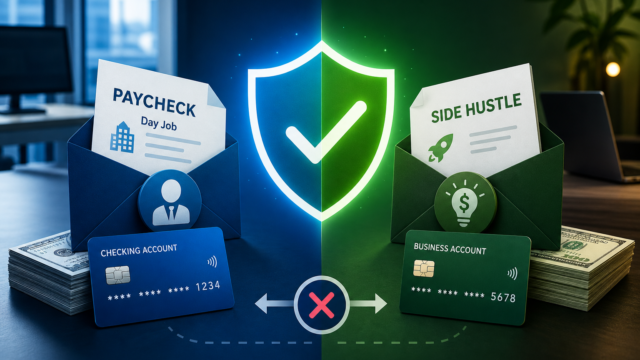
You kick off your side hustle feeling excited, picturing a smooth stream of extra cash landing in your everyday account. At first, it really does seem simple—a client pays you here, you buy some supplies there, all blended in with your weekly groceries and rent. Then it hits you: you can’t tell which transactions are personal and which are business. That payment from a client?
It’s mixed up with the birthday cash your aunt sent. As tax season rolls around and you try to break down what counts as income, deductions, or actual profit, everything turns into a confusing puzzle. That “what now?” moment is more common than you’d think, and for many, it’s the first real sign that it’s time to open a separate bank account just for your side hustle.
Your Side Hustle Brings in Over $400 a Year
Most people don’t realize there’s a hard line set by the IRS: if your side gig brings in more than $400 a year, things officially change. This isn’t just a guideline. Once you hit that number, you’re required to report your profits or losses on Schedule C and calculate self-employment tax on Schedule SE. At this point, the IRS treats your side hustle as a real business for tax purposes, even if it still feels like something you just do from your couch.
Once you cross that line, mixing your business income with daily expenses gets messy fast. If you ever need to prove to the government what you really earned or spent, combing through bank statements to separate little deposits or figuring out if an Amazon purchase was for you or your business wastes time and energy. And if the IRS comes calling for details, you’ll be relieved to have a clear record in a dedicated account.
SoFi, a leader in personal finance, makes it clear: separating your side hustle money from the rest of your finances is the only way to know for sure what your business actually brings in. If you’ve hit that $400 mark, don’t put it off—open a business account just for your hustle.
Passing that threshold usually means you’ll face new tax responsibilities, like making quarterly estimated payments or needing to document deductible expenses. Keeping your business income and costs in one place means you can handle these obligations without losing sleep.
And this isn’t just for people who rely on their side hustle to pay the bills. Even if you’re just picking up occasional gigs, as soon as you cross the $400 line, you’re on the IRS’s radar. If that’s your situation, start separating your finances now, before things spiral into a bigger headache.
You’ve Registered an LLC or Corporation for Your Side Hustle
A lot of folks decide to make things official by forming an LLC or corporation, thinking it automatically shields them from liability. But in reality, simply getting a separate tax ID doesn’t do much if business money keeps flowing through your personal account. Mixing everything together can wipe out the legal protection you set up when you registered your business.
Imagine you create an LLC to offer consulting, but all your payments still land in your old personal checking account. If your business ever faces a lawsuit, it’s going to be much harder to prove that your company is truly separate from you as an individual. Judges often look at whether you kept the finances apart when deciding if your personal assets can be tapped for business debts.
Mercer Savings Bank spells it out: LLCs and corporations need their own business bank account to keep what’s called the “corporate veil” intact. This isn’t just a technical detail—it’s a practical rule. If you don’t keep the money separate, you risk losing the very protection your LLC or corporation was meant to give you.
Even if you’re a sole proprietor without a formal entity, having a dedicated account makes you look more professional and keeps things organized. It’s not legally required for independent contractors, but both the IRS and most banks strongly recommend setting it up early so you don’t end up sorting out a mess later.
The earlier you make this a habit, the easier it is to grow. If you ever want to hire someone, apply for a loan, or even sell your business, having a clean, separate financial history is a huge asset—one you’ll really appreciate when the time comes.
You’re Getting Paid Regularly or Have Ongoing Business Expenses

A lot of side hustles start with the occasional payment, which feels simple enough to handle in your personal account. But the minute you land a steady client, sign monthly contracts, or rack up regular expenses (like tools, licenses, or ads), things can get complicated fast.
Here’s the red flag: if you’re sending invoices every month or have supplier bills coming in regularly, it’s past time to open a dedicated business account. It streamlines all your payments and expenses and makes it clear what’s profit and what’s just money moving through.
Take Rafaela, for example. She started out selling custom desserts. At first, payments landed in her personal account and she bought ingredients along with her household groceries. Once orders started coming in weekly, she couldn’t figure out if she was actually making money. Switching to a business account didn’t just help her see her real income; it made it easier to negotiate with suppliers and keep track of her business’s growth.
When you route all client payments and business expenses through one account, it’s a lot simpler to see how your side hustle is really performing. You can quickly spot what came in, what went out, and where you might trim costs or invest more.
This kind of control is also key for avoiding tax surprises or finding out—too late—that you’re racking up unnecessary bank fees by running everything through your personal account. And with everything separated, it’s a breeze to prove your income or pull together paperwork for loans or partnerships.
Tax Time Is Getting Messy or Stressful
Tax season is when the difference between organized and mixed-up finances really shows. If you’ve ever spent hours sorting through payments, trying to split up what was for business and what was just family spending, you know how draining it can be.
The fix is straightforward: every dollar in and out of your side hustle should move through a specific account. Once a month, review your transactions—label each one as income, supply purchase, ad spend, or shipping cost. Then, when it’s time to fill out Schedule C and, if you passed $400, Schedule SE, everything’s already sorted. Just add up the totals for each category.
Doing this cuts down on mistakes and helps you avoid penalties, plus it lets you spot tax deductions you might have missed. With everything documented, you won’t be left guessing what’s eligible when the IRS asks questions.
SoFi points out that keeping your side hustle finances separate is the key to staying on top of tax requirements and maximizing what you keep. Whether you file your own taxes or hire an accountant, you’ll save time—and sometimes money—by not having to untangle mixed-up records.
There’s another practical bonus: a clean business account history makes it easier to prove your income for loans, rental applications, or even when pitching to investors. That kind of track record is pure gold when you’re ready to take your business up a notch.
You Want to Simplify Your Finances Without Breaking the Bank

Some people put off opening a business bank account for their side hustle because they worry about extra fees or paperwork. That’s understandable, especially if you’re just getting started and watching every dollar. But now there are options designed to make things easier for freelancers and small business owners.
Digital banks like Bluevine, Mercury, and Novo usually offer zero monthly maintenance fees and don’t require a minimum balance to open an account. This means you can keep your business finances separate from the start without blowing your budget. These accounts are perfect if you run everything online, don’t need to deposit cash, and want convenience.
Traditional banks like Chase or Bank of America require an initial deposit—usually between $25 and $100—and charge monthly fees ranging from $15 to $30. These can often be waived if you keep a certain balance or have enough activity. If you prefer a branch or deal with cash, these banks are still a good fit, but you’ll need to weigh whether the extra cost is worth it.
The key is to look at your actual needs. If your side hustle is all online and you want simplicity, digital bank accounts do the trick. If you need in-person service, get ready for higher fees. Either way, don’t let paperwork or fear of bureaucracy hold you back—opening a business account is fast and accessible for almost everyone these days.
Separating your finances also helps you avoid surprise fees in your personal account and possible freezes for using it commercially. Plus, with a dedicated business account, you can negotiate better terms with your bank because you show them you’re organized and have real growth potential.
Building Better Habits for Your Side Hustle’s Future
Getting a business bank account isn’t just checking a box—it’s a mindset shift that gets your business ready for real growth. The best time to open one is as soon as you notice regular income or expenses. From there, set a rule: every client payment goes in, every business expense comes out. Don’t mix, even if it seems easier for the moment.
Make it a habit to review your statement each month and categorize income and expenses. This gives you a clear picture of where you’re earning most, where you can cut back, and when you’re ready to invest. If you ever need to show proof of income for a loan or get audited, you’ll have all your paperwork ready—no last-minute scramble.
A common mistake is putting off opening a business account, then wasting days trying to untangle mixed transactions. If you start organized, you have more time to focus on what really matters: growing your business, landing new clients, and seizing new opportunities.
The difference between a side hustle that’s a mess and one that’s ready to take off comes down to habits like this. Setting up and using a dedicated business bank account is what takes you from winging it to actually planning—and it might be the smartest move you make for your peace of mind and your bottom line.